
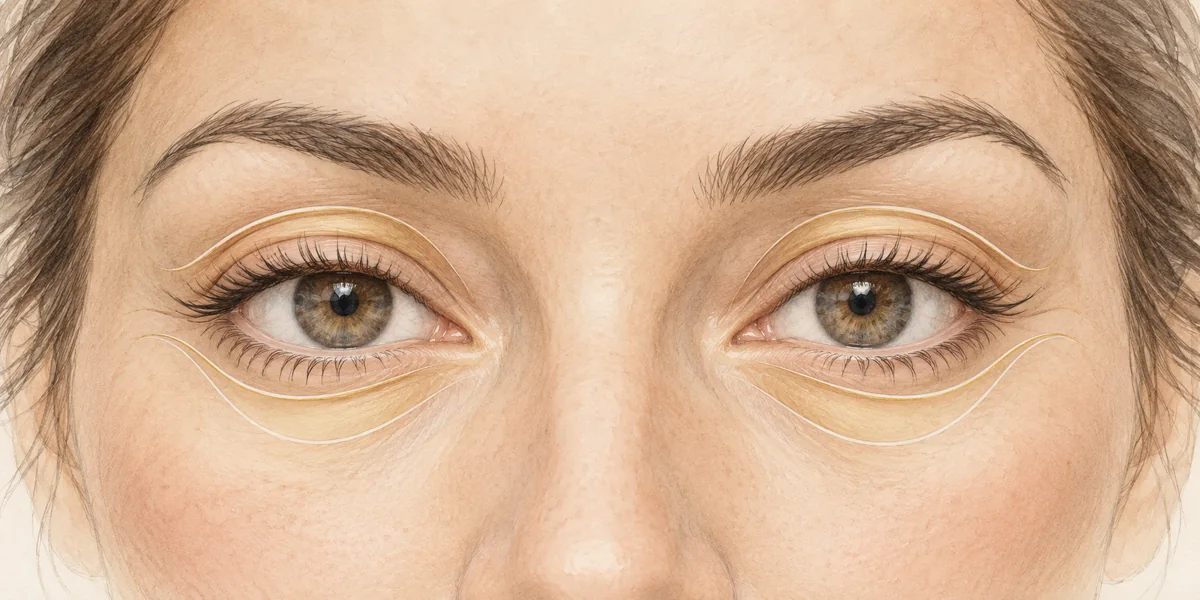
Upper and lower blepharoplasty, in detail.
Upper blepharoplasty allows excess skin to be removed in a carefully planned way and, when indicated, other tissues that contribute to aging in the area to be treated as well.
Read the full explanation ↓Close ↑
Blepharoplasty is a surgery designed to treat the changes that occur around the eyes as a result of aging, genetics and individual anatomical features.
It can address excess skin on the upper eyelids, lower eyelid bags and certain changes in the contour around the eyes.
The current goal of blepharoplasty is not simply to remove skin or fat, but to rejuvenate the periocular region while preserving tissue, volume and support whenever possible, aiming for a natural look and avoiding an overdone, "operated" look.
Upper blepharoplasty
Reduces excess skin and improves the definition of the upper eyelid
Over time, the skin of the upper eyelid can lose elasticity and develop folds or excess tissue that make the eyes look tired, heavy or older.
In certain patients, the excess skin can be significant enough to partially interfere with the field of vision.
Planning is essential: excessive removal of skin, muscle or fat can cause functional problems or a hollowed appearance. For this reason, contemporary techniques favor a more conservative, personalized approach.
What can we improve with an upper blepharoplasty?
It may be indicated to improve:
- Excess skin and folds of the upper eyelid.
- The appearance of tired or heavy-looking eyes.
- Loss of definition of the eyelid crease.
- Certain prominent fat pads.
- Correctable asymmetries.
- Excess skin that may partially compromise the field of vision.
Lower blepharoplasty
Improves bags and excess skin of the lower eyelid, aiming for a more harmonious transition between the eyelid and the cheek
Aging of the lower eyelid is a complex process that can involve skin, muscle, fat pads, ligaments and loss of tissue support.
Bags under the eyes can appear because of greater visibility or protrusion of orbital fat, while changes in the skin and supporting structures can cause laxity and contour irregularities.
For this reason, a modern lower blepharoplasty is not simply "removing the bags." The procedure must be adapted to each patient's anatomy.
What can we improve?
Depending on individual anatomy, lower blepharoplasty can be used to treat:
- Prominent bags under the eyes.
- Excess skin or laxity.
- A persistent tired appearance.
- Contour irregularities of the lower eyelid.
- A marked transition between the eyelid and the cheek.
- Certain asymmetries of the periocular region.
Boomerang technique
Precise treatment of excess skin of the lower eyelid
The Boomerang technique is a published approach to lower blepharoplasty aimed specifically at managing excess skin.
Its design allows a calculated resection of skin along a superolateral vector, aiming to improve skin laxity of the lower eyelid while carefully controlling the amount and direction of the tissue removed.
The resection takes a characteristic shape that gives the Boomerang technique its name.
One of the fundamental principles of this technique is a conservative, precise treatment of the skin, aiming to avoid excessive resections that could create tension on the lower eyelid.
When other components of periocular aging are present, such as fat pads, support problems or changes in the transition between the eyelid and the cheek, the technique can be complemented with other procedures according to the patient's anatomical needs.
The choice of this technique depends on the amount and distribution of excess skin, the position and stability of the lower eyelid, and each patient's individual characteristics.
Combined upper and lower blepharoplasty
Comprehensive rejuvenation of the eyes
When there are changes in both the upper and lower eyelids, both procedures can be performed together.
This allows excess upper skin, lower bags and certain changes in the periocular contour to be addressed comprehensively, aiming to maintain a harmonious relationship among the different structures around the eyes.
Not every patient needs all four eyelids treated. The indication is determined during the medical assessment.
Does blepharoplasty remove dark circles?
Not all dark circles have the same cause.
They can be related to pigmentation, blood vessels, bone anatomy, volume loss, fat pads or shadows created by the transition between the eyelid and the cheek.
Blepharoplasty can improve some structural components that cause shadowing or contour irregularities, but it does not necessarily remove the pigmentation of the dark circle.
Identifying the predominant cause makes it possible to determine whether treatment requires surgery, procedures to improve skin quality, volume management or other alternatives.
Assessment and planning
The periocular region has complex anatomy and requires an individual evaluation before the surgery is defined.
During the assessment, we analyze the amount and distribution of excess skin, fat pads, tissue quality, eyebrow position, support and position of the lower eyelid, the relationship between the eyelid and the cheek, symmetry and ophthalmologic history.
Based on this evaluation, we determine whether an upper, lower or combined blepharoplasty is indicated and which approach is most appropriate.
The goal is a more rested, rejuvenated look that preserves the patient's function, expression and individual features.