
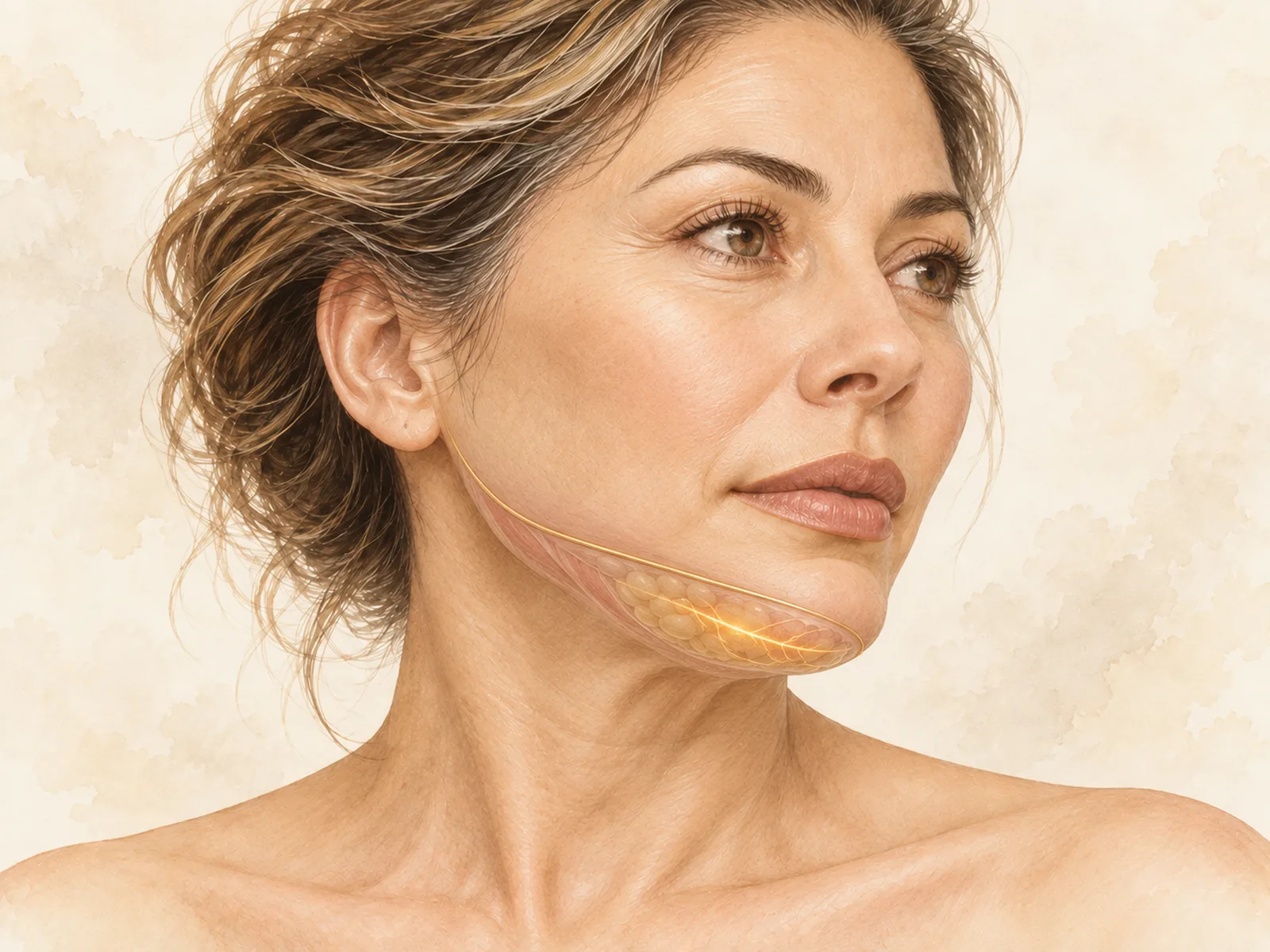
Endolifting + laser lipolysis for a double chin, in detail.
Endolifting is a minimally invasive procedure in which a very thin optical fiber is introduced under the skin to deliver laser energy directly into the subdermal tissue.
Read the full explanation ↓Close ↑
Loss of definition between the face and the neck can be related to several factors: accumulation of submental fat, skin laxity, decreased firmness of the tissues, jaw anatomy and changes associated with aging.
The combined treatment of endolifting + laser lipolysis of the double chin aims to act on two important components of the cervicofacial contour: localized fatty tissue and tissue laxity.
A small-caliber laser fiber is introduced into the subcutaneous plane to deliver energy in a controlled way to the selected areas.
The goal is a more defined jawline and neck contour, using a less invasive approach than open surgery in properly selected patients.
What is endolifting?
Subdermal remodeling with laser energy
The controlled thermal interaction of the laser with the tissues aims to produce immediate contraction of certain fibers and a later process of collagen remodeling.
This process can progressively improve the firmness of the skin and how it adapts to the new contour.
Results depend on factors such as the degree of laxity, skin quality and thickness, age, anatomy and the amount of fatty tissue present.
What is laser lipolysis?
Treatment of localized fat deposits with laser energy
Laser lipolysis uses energy delivered into the subcutaneous tissue with the aim of producing a thermal effect on fatty tissue and facilitating its reduction and remodeling.
In the submental region, it can be used to treat fat deposits that contribute to the formation of a double chin.
Depending on the amount of fat and the technique used, the treatment can be complemented with removal of the fatty tissue by suction.
Laser lipolysis should not be considered a weight-loss treatment. It is directed at localized fat deposits in selected patients.
Why combine endolifting and laser lipolysis?
Less volume and better tissue adaptation
Reducing double-chin fat is not always enough to achieve good neck definition.
When there is some degree of laxity, reducing volume alone can make excess skin or loss of firmness more noticeable.
The combination makes it possible to address the following in a complementary way:
- Localized fat: through laser lipolysis.
- Mild to moderate laxity: through subdermal heating and tissue remodeling.
- Jawline: aiming for a more defined transition between the face and the neck.
- Submental region: reducing volume and helping the tissues adapt.
- Skin quality and firmness: through the progressive process of collagen remodeling.
The goal is not simply to "eliminate the double chin," but to analyze the different components that cause the loss of cervicofacial definition.
What areas can we treat?
Depending on the anatomy and the device used, the treatment can be directed at the submental region, the jawline and certain areas of the neck.
The amount of energy, depth, distribution of passes and the need to treat fat are determined individually.
Who may be a candidate?
It may be considered for patients who have:
- Localized fat under the chin.
- Mild or moderate loss of jawline definition.
- Mild or moderate skin laxity.
- A combination of localized fat and decreased firmness.
- Interest in a less invasive alternative, with anatomy suited to this type of treatment.
Not all cases of double chin have the same origin.
A retruded chin, platysmal bands, prominent submandibular glands, significant excess skin or advanced laxity can contribute to the neck contour and are not necessarily corrected adequately with laser lipolysis or endolifting.
Does it replace a neck lift?
Not in every patient
Endolifting can be useful when there is mild or moderate laxity and good tissue quality.
When there is significant excess skin, advanced descent of tissues, significant platysmal bands or other structural changes, a surgical procedure may provide a more complete correction depending on the case.
For this reason, the choice between a minimally invasive treatment and surgery should be based on anatomy and not only on a preference for avoiding surgery.
Results
Some of the change from reduced volume may be noticeable during the early stages of recovery.
However, the tissue response continues to evolve over the following weeks and months as swelling resolves and collagen remodeling takes place.
The degree of improvement varies and depends on the starting anatomy, amount of fat, laxity, skin quality and individual biological response.
The goal is better definition of the cervicofacial angle and the jawline while maintaining a natural result.
Assessment and planning
Before recommending endolifting + laser lipolysis, we evaluate the amount and distribution of submental fat, skin quality and thickness, degree of laxity, chin projection, jawline definition, neck anatomy and the characteristics of the platysma.
This assessment makes it possible to determine which component is producing the double chin and whether the patient would benefit from lipolysis, subdermal remodeling or a combination of both.
When there are structural problems that cannot be adequately corrected with laser, the available alternatives are explained.
The goal is better definition of the jawline and neck contour through personalized treatment, without recommending minimally invasive procedures to patients who truly need surgical correction.