
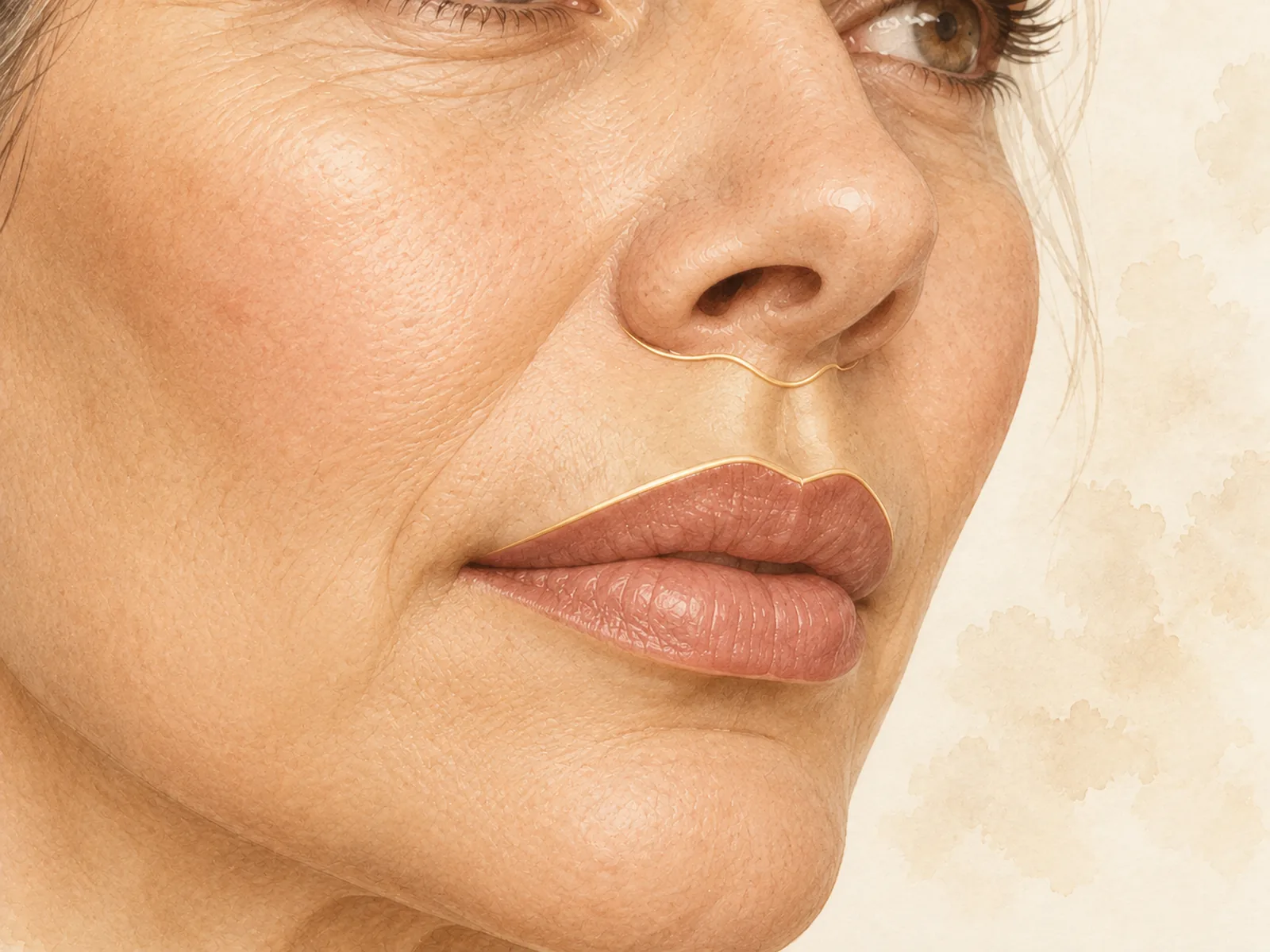
Lip lift, in detail.
There are different techniques. They include the indirect, or subnasal, lip lift and the direct lip lift, and the choice depends on each patient's anatomy and goals.
Read the full explanation ↓Close ↑
A lip lift is a surgical procedure designed to modify certain proportions of the upper lip.
It can be used to decrease the distance between the nose and the lip, increase vermilion show and improve the relationship between the upper lip, the nose and the teeth.
Unlike a hyaluronic acid filler, a lip lift does not mainly aim to add volume by injecting a product. Its goal is to produce a structural change in the position and show of the lip.
Indirect lip lift
Shortens the upper lip and increases vermilion show through an incision placed under the nose
The indirect lip lift, also known as a subnasal lift, is indicated mainly for patients who have an increased distance between the base of the nose and the edge of the upper lip.
During the procedure, a carefully planned amount of skin is removed immediately under the nose.
When the incision is closed, the upper lip moves upward, shortening the skin portion of the lip and increasing vermilion show.
What can we improve?
Depending on the patient's anatomy, the indirect lift can:
- Decrease the distance between the nose and the upper lip.
- Increase vermilion show.
- Improve the proportion between the upper and lower lip.
- Increase upper tooth show at rest.
- Improve certain changes associated with aging of the lip.
- Create a more defined upper lip without relying exclusively on volume.
Where is the scar?
The incision is designed at the junction between the base of the nose and the upper lip, aiming to use the natural folds and transitions of this region to make it less noticeable.
As with any surgical procedure, there is a permanent scar. Its final appearance depends on the technique, tension on the wound and individual healing characteristics.
Direct lip lift
Directly increases vermilion show and allows precise modification of the lip border
In the direct lip lift, the skin resection is made immediately above the vermilion border of the upper lip.
By removing a carefully calculated amount of skin and closing the incision, the edge of the lip moves upward, directly increasing the amount of visible vermilion.
This technique can be useful when the main goal is to increase the show of the red lip or to precisely modify certain features of its contour.
What can we improve?
The direct lift can be used to:
- Increase vermilion show.
- Improve the definition of the lip border.
- Improve certain asymmetries.
- Make a thin upper lip more visible, without relying only on fillers.
- Treat certain lip changes related to aging.
What is the difference between a direct and an indirect lip lift?
The main difference is where the resection is made and where the scar ends up.
In the indirect lift, the incision is placed under the nose. The procedure shortens the distance between the nose and the lip and secondarily produces greater vermilion show.
In the direct lift, the incision is made immediately along the edge of the lip. This directly increases vermilion show, but it means the scar is closer to the contour of the lip.
Neither technique is universally superior. The choice depends on the length of the upper lip, tooth show, the amount of visible vermilion, nasal anatomy, skin quality, facial proportions and the patient's tolerance for the location of the scar.
Lip lift vs. hyaluronic acid
They do not aim for exactly the same result
Hyaluronic acid can be used to modify the volume, projection, structure, hydration and contour of the lip.
A lip lift mainly modifies the position, length and show of the upper lip.
In patients with a long upper lip, repeatedly adding volume with fillers does not necessarily correct the vertical proportion between the nose and the lip.
For this reason, during the assessment we determine whether the goal requires volume, surgical repositioning or a carefully planned combination of both.
Who may be a candidate?
A lip lift may be considered for patients who have:
- An increased distance between the nose and the upper lip.
- Decreased vermilion show.
- Little show of the upper teeth at rest.
- Changes in the length and shape of the lip associated with aging.
- Certain asymmetries.
- A wish to change the show of the lip without relying exclusively on fillers.
The indication does not depend only on a measurement in millimeters. The lip must be analyzed within the complete proportions of the lower third of the face.
Assessment and planning
Before a lip lift, we evaluate the length of the upper lip, vermilion show, tooth show at rest and when smiling, nasal anatomy, lip mobility, symmetry and the proportions of the lower third of the face.
We also look at previous procedures, the presence of fillers and individual healing characteristics.
Based on this assessment, we determine whether a lip lift is indicated, which technique offers the best balance between benefit and scar, and how much tissue should be modified.
The goal is to improve the proportions of the upper lip, aiming for a harmonious, natural result that is consistent with the individual features of the face.